
Most architectural acoustics questions on a building project come down to a handful of numbers, and each one answers a different question. This page sorts them out. The four guides below go deeper, written for the people who commission the work: architects, developers, school districts, church building committees and public agencies.
- STC and IIC ratings: what walls and floors are tested for
Airborne and impact sound are rated separately. How the ASTM tests work, what the field ratings add, and what California requires between dwelling units.
- NC curves: rating the background noise from HVAC
Why a room can read “quiet” in dBA and still rumble, how an NC rating is read, which targets public guidance gives, and where HVAC noise gets into a room.
- What a CEQA noise study covers in California
The three noise questions in the CEQA checklist, where the thresholds come from, how CNEL and Leq(h) differ, and what a sound wall can and cannot do.
- Church acoustics: one room for the sermon and the choir
Why a sanctuary that flatters the organ can blur the sermon, how much a full congregation changes reverberation, and which changes keep the room’s character.
Five numbers, five questions
Ratings for walls and floors describe an assembly. Reverberation and background noise describe a room. CNEL and Leq describe a place. Mixing the families up is a classic mistake in architectural acoustics: a panel that shortens a room’s RT60 barely changes the STC of the wall behind it.
| Rating | The question it answers | Standard or rule | Guide |
|---|---|---|---|
| STC | How much airborne sound does a wall or floor stop in the laboratory? | ASTM E90, ASTM E413 | STC and IIC ratings |
| IIC | How much tapping-machine impact sound does a floor-ceiling assembly pass to the room below, in the laboratory? | ASTM E492, ASTM E989 | STC and IIC ratings |
| RT60 | How long does sound linger after the source stops? | Estimated with Sabine’s formula; classroom limits in ANSI/ASA S12.60 | Church acoustics |
| NC | How loud, band by band, is the background noise from building systems? | ASA/ANSI S12.2-2026 | NC curves |
| CNEL, Leq(h) | How much noise reaches a site over a day, or in its loudest hour? | Government Code 65302(f); 23 CFR 772 | CEQA noise studies |
Several ratings also have field versions and companions. STC has NNIC and ASTC for tests in finished buildings, IIC has NISR and AIIC, and NC has an A-weighted alternative in the same standard. Classroom reverberation and background noise limits are set out in the classroom acoustics interview on this site, next to the criteria one family had written into a student’s IEP.
A little decibel arithmetic
A decibel compares a sound with a reference level on a logarithmic scale, so decibels do not add like ordinary numbers. Caltrans’ Technical Noise Supplement gives the standard example: two cars at 70 dB passing together produce 73 dB, not 140. Any two equal sources together are 3 dB louder than either one alone.
- A 10 dB increase is generally perceived as a doubling of loudness. Caltrans cites this concept when it explains its 12 dB test for a substantial traffic noise increase.
- Sound from a single point source drops about 6 dB for each doubling of distance. A busy road behaves like a line source and drops about 3 dB per doubling over hard ground.
- A-weighting, written dBA, turns down the low and the highest frequencies to follow the ear. It makes a good survey number and a weak tool for rumble.
- Leq is the steady level with the same sound energy as a fluctuating noise over a period. Ldn is a 24-hour version with a 10 dB penalty for night hours; CNEL also adds almost 5 dB to the evening hours.
Blocking, absorbing and quieting the source
Architectural acoustics works with three different tools, and each has its own ratings.
Blocking
Blocking keeps sound from passing from one space to another. Mass, airtight construction and separating the two sides of a wall all help, and STC and IIC measure the result. The party wall between two condominiums and the floor between stacked units are blocking problems.
Absorbing
Absorbing turns part of the sound striking a surface into heat, so less returns to the room. It shortens reverberation and lowers the build-up of noise in busy rooms. Acoustical ceiling tile in a classroom and cushions on church pews are absorption measures, rated by absorption coefficients and checked with RT60.
Quieting the source
Choosing and isolating equipment and slowing the air in ducts work at the source. A sound wall along a freeway works on the path, close to the source. NC describes the result indoors, CNEL and Leq outdoors.
Which questions come up on which projects
Condominiums and apartments
The California Building Code sets STC and IIC minimums between dwelling units and limits interior noise from outside sources to 45 dB, as Ldn or CNEL. Near a freeway, the noise element of the general plan adds land use questions, and CEQA review covers the noise the project itself adds.
Schools
Classrooms have their own American National Standard, ANSI/ASA S12.60, with limits on background noise and reverberation. San Diego City Schools and Poway Unified School District appear on the firm’s client list.
Churches and multipurpose rooms
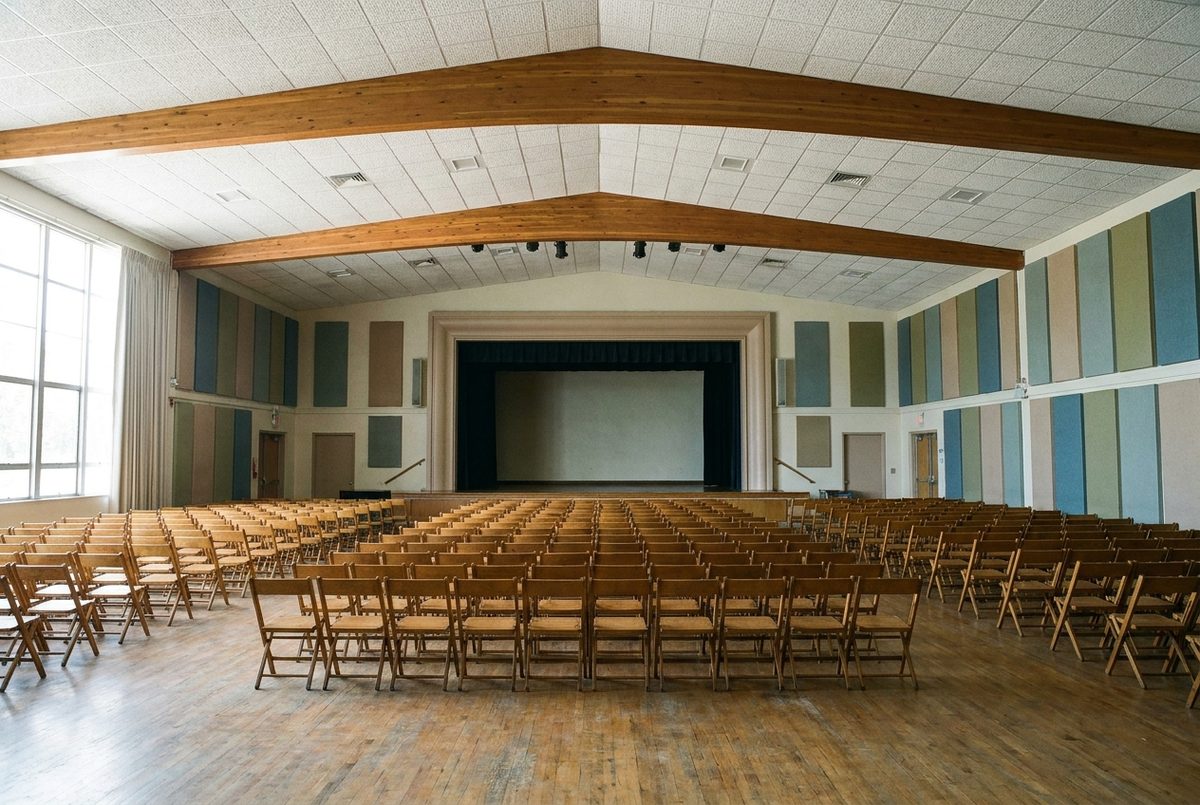
One room has to carry a sermon and a choir, and its reverberation changes when the congregation arrives. Churches appear on the client list as well.
Offices and buildings with rooftop equipment
Background noise targets come from the design brief, and the noise itself comes from fans, ducts and diffusers. Public guidance from the General Services Administration gives NC targets by room type.
Roads, pipelines and other infrastructure
Construction noise and vibration near homes are part of the review on these projects. Federal-aid highway work also follows the Caltrans traffic noise protocol. The firm’s listed infrastructure projects included the Moreno-Lakeside Pipeline, the Plaza Blvd Road Widening and Caltrans Hwy 210/30; the full list is on the clients and projects page.
When architectural acoustics enters the schedule
Acoustic decisions are easiest to make on early drawings. Room volume and shape are set in schematic design. So is the site plan that decides which façade faces the freeway, and the mechanical layout that puts a rooftop unit above the boardroom or away from it.
Wall and floor assemblies follow in design development. Tests at the end confirm what was built: field isolation tests (NNIC or ASTC for walls, NISR or AIIC for floors), RT60 and background noise measurements. An ASHRAE Journal column makes the point about impact noise directly: it cannot easily be fixed in a later design phase, and especially not after construction has begun.
The firm’s consulting services covered both ends of that schedule: design and treatment recommendations, and acoustical measurements of ambient noise, STC and RT60.
Standards and sources
- ASTM E413-22, Classification for Rating Sound Insulation.
- ASTM E989-21, single-number metrics for impact noise.
- ASA/ANSI S12.2-2026, Criteria for Evaluating Room Noise.
- California Building Code, 2025 edition, Chapter 12, Section 1206 Sound transmission.
- Caltrans, Technical Noise Supplement: decibel addition, spreading with distance, CNEL and Ldn.
- HyperPhysics, Reverberation Time, Georgia State University.
- ANSI/ASA S12.60, acoustical performance criteria for schools: Part 1 permanent schools, Part 2 relocatable classrooms.
- 23 CFR 772, Table 1 Noise Abatement Criteria.
- California Government Code, section 65302(f): the general plan noise element.
- ASHRAE Journal, Engineer’s Notebook, “Learning a Vocabulary for Acoustics Fundamentals.”