
A developer plans apartments between a freeway and a busy arterial in San Diego County. The city’s initial study reaches the noise section of the CEQA checklist, and someone has to answer it with numbers. That job falls to a CEQA noise study. The technical report measures the noise there now, predicts what the project adds, compares both with the applicable standards, and proposes mitigation where the comparison fails.
The three noise questions in the checklist
Appendix G of the State CEQA Guidelines contains a sample environmental checklist. Its noise section, XIII, asks whether the project would result in:
- a substantial temporary or permanent increase in ambient noise near the project, in excess of standards in the local general plan or noise ordinance, or standards of other agencies;
- excessive groundborne vibration or groundborne noise;
- excessive noise for people living or working on the site, if it lies near a private airstrip or within the area of an airport land use plan.
Where no airport land use plan has been adopted, the third question applies within two miles of a public airport or public use airport.
The Guidelines call the form a sample that agencies may tailor. They also say its questions do not necessarily represent thresholds of significance. The numbers come from elsewhere.
Where the thresholds come from
CEQA defines the environment to include noise, but the statute sets no decibel limit. Section 15064.7 of the Guidelines describes a threshold of significance as an identifiable quantitative, qualitative or performance level. It encourages each agency to adopt its own. A CEQA noise study therefore works through several layers of local, state and federal rules.
The general plan noise element
Government Code section 65302(f) requires every city and county general plan to include a noise element. It must identify noise from highways and freeways, arterials, rail, airports and industry, and show noise contours as CNEL or Ldn. The contours serve as a guide for land use patterns that keep residents’ exposure to excessive noise low.
The local noise ordinance
A noise ordinance is the local rule for noise at property lines and for construction. In unincorporated San Diego County, the County Noise Ordinance sets sound level limits and controls when construction equipment may run. Incorporated cities have their own codes.
The federal highway rule and Caltrans
23 CFR 772 applies to highway projects that use federal-aid funds or need FHWA approval, whatever the funding. Caltrans applies it through its Traffic Noise Analysis Protocol. The rule sets Noise Abatement Criteria as one-hour Leq values. In California a predicted level within 1 dBA of the criterion counts as approaching it. An increase of 12 dBA or more over the existing worst-hour level counts as a substantial increase.
| Category | Land use, excerpt | Leq(h), dBA | Evaluated |
|---|---|---|---|
| B | Residential | 67 | Exterior |
| C | Schools, places of worship, parks, hospitals, libraries and similar uses | 67 | Exterior |
| D | Auditoriums, places of worship, schools, hospitals, libraries and similar uses | 52 | Interior |
| E | Hotels, motels, offices, restaurants and other developed land | 72 | Exterior |
The Protocol is cautious about CEQA thresholds. It states that no single numerical threshold is used on all projects. It also warns that the 12 dB increase should not automatically be applied. It names a quiet rural setting where a smaller increase could matter, and a noisy urban one where 12 dB might not be significant.
CNEL, Ldn and Leq(h)
Leq is the steady level that carries the same sound energy as the fluctuating noise over a stated period. Leq(h) is its one-hour value and the metric of the highway rule. General plans describe noise over a whole day instead.
- Ldn averages the 24 hours after adding 10 dB to every hour between 10 p.m. and 7 a.m.
- CNEL adds the same night penalty and also almost 5 dB to the evening hours from 7 to 10 p.m.
Caltrans’ Technical Noise Supplement notes that CNEL normally comes out about half a decibel higher than Ldn for the same day of data. Government Code section 65302(f) lets a general plan use either one.
What a CEQA noise study does, step by step
- Measure existing noise. Monitors running for a full day give CNEL or Ldn, and shorter readings at several points fill in the site.
- Predict the future. Traffic noise is modeled from volumes, speeds and truck mix. For federal-aid highway work the approved model is the FHWA Traffic Noise Model, which the Protocol notes has been validated within 500 feet of the highway.
- Add the project’s own sources: parking structures, loading docks, and noise from rooftop HVAC equipment, checked at the nearest homes.
- Assess construction. Equipment, schedule and distance to neighbors decide the construction noise, and pile driving or vibratory compaction near buildings is a typical subject of the vibration question. Caltrans publishes a vibration guidance manual for transportation and construction work.
- Compare with the thresholds and propose mitigation where they are exceeded.
A little decibel arithmetic keeps traffic predictions in proportion. Two equal sources together are 3 dB louder than one: Caltrans’ example combines two cars at 70 dB into 73 dB. So a project that doubles the traffic on a road, with speeds and truck share unchanged, raises its noise by about 3 dB. Reaching the 12 dB highway test would take about sixteen times the traffic. Caltrans bases that test on the concept that a 10 dB increase is generally perceived as a doubling of loudness.
Sound walls, buildings and windows
A sound wall works by breaking the line of sight between the traffic and the listener. The Technical Noise Supplement notes that a barrier just tall enough to graze that line still provides about 5 dBA. For Caltrans, abatement counts as feasible only if it is predicted to reduce noise by at least 5 dB at an impacted receptor.
Freeway, sound wall and a two-story apartment building, section. Schematic, not to scale.
- Traffic: the noise source, close to the road surface
- Sound wall
- The line of sight to the patio is broken, so the wall shields it
- Sound bending over the top of the wall still reaches the patio, at a lower level
- The second-floor window sees over the wall and gets little shielding
- Exterior wall and windows bring indoor noise down to the interior limit
- Microphone measuring the existing noise
Upper floors are the hard part. A second-story bedroom that looks over the wall gets little from it, so the design turns to the building itself. Parking structures or commercial space along the freeway edge can shield the homes behind them. Windows, exterior walls and ventilation then carry the rest, so residents can keep windows closed on loud days and still have fresh air.
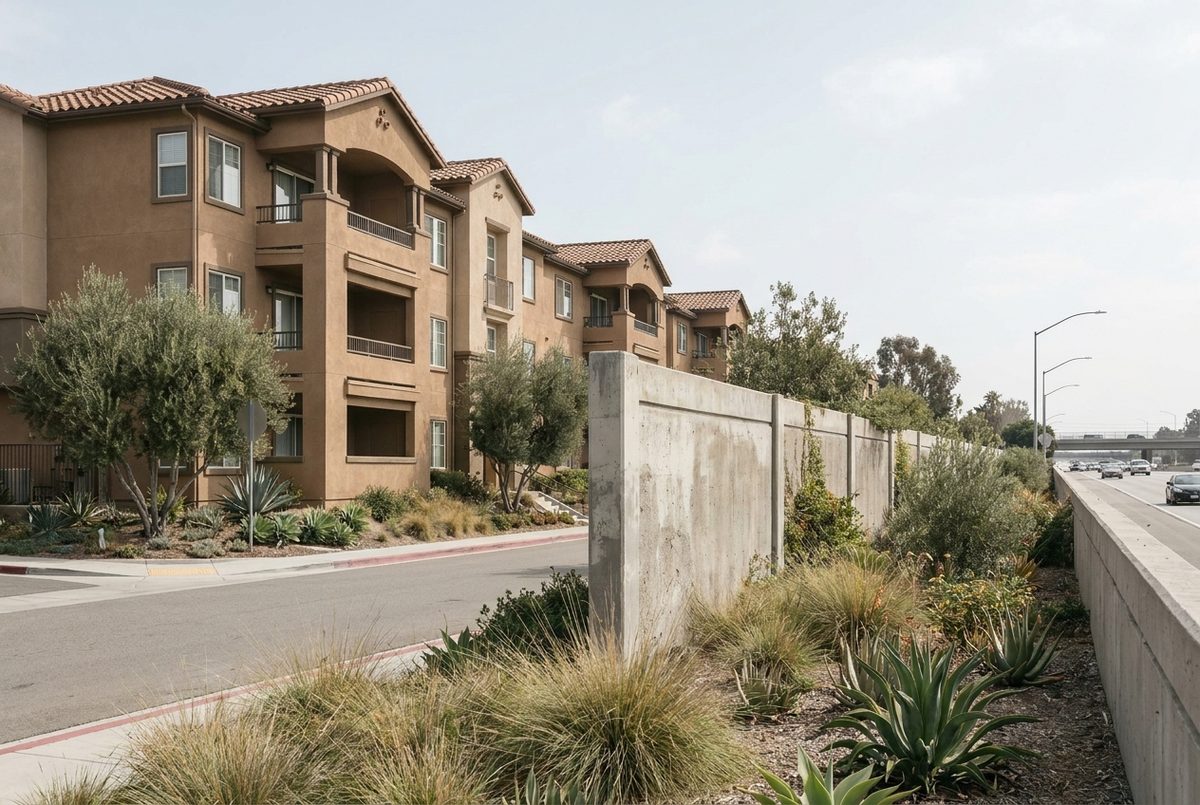
New homes beside a freeway: CEQA or the building code?
In California Building Industry Association v. Bay Area Air Quality Management District, the California Supreme Court addressed the question. CEQA generally does not require an analysis of how existing environmental conditions affect a project’s future residents or users. It does require one when the project risks making those conditions worse. Special rules also apply to certain airport, school and housing projects.
Freeway noise reaching new apartments can therefore fall outside the CEQA impact analysis. It is then handled by the land use policies of the noise element and by the California Building Code, Title 24, Part 2. Section 1206.4 limits interior noise from exterior sources to 45 dB in any habitable room, as Ldn or CNEL to match the general plan. Section 1206 also sets the STC and IIC minimums between units.
Where a federal agency funds or approves a project, NEPA review applies as well, and the Caltrans Protocol covers noise under both laws. The firm listed both kinds of work among its environmental acoustics services: CEQA/NEPA technical noise impact studies and Title 24 exterior-to-interior noise analyses. Places of worship appear twice in the federal table above, and the guide to church acoustics covers the inside of those rooms. The ratings behind all of this are summarized in the acoustics guides overview.
Questions clients ask
Does every project need a CEQA noise study?
No. Exempt projects need none. For the rest, the lead agency decides through the initial study, and each checklist answer needs supporting evidence. When a project adds traffic, equipment or construction near homes, schools or other noise-sensitive uses, a technical noise study is the usual way to provide that evidence.
What counts as a substantial noise increase?
CEQA does not say. A CEQA noise study applies the lead agency’s own thresholds, usually tied to the general plan noise element and the noise ordinance. For federal-aid highway projects Caltrans treats an increase of 12 dBA or more as substantial, but its own Protocol warns against using that figure for every CEQA case.
Will a sound wall protect the second floor?
Only partly. A barrier helps where it breaks the line of sight between the traffic and the listener. A second-story window that sees over the wall gets little benefit, so upper floors depend more on site planning, windows and exterior walls designed for the noise level.
Is CNEL the same as Ldn?
Nearly. Both are 24-hour averages with a 10 dB penalty at night. CNEL also weights the evening hours by almost 5 dB, and Caltrans notes that it normally comes out about half a decibel higher than Ldn. The general plan noise element decides which one a jurisdiction uses.
Standards and sources
- State CEQA Guidelines, California Code of Regulations, Title 14: Appendix G, section XIII Noise.
- CEQA Guidelines, section 15064.7, thresholds of significance.
- California Public Resources Code, section 21060.5: definition of the environment, including noise.
- California Government Code, section 65302(f): the general plan noise element, CNEL or Ldn contours.
- 23 CFR 772, procedures for abatement of highway traffic noise and construction noise, Table 1 Noise Abatement Criteria.
- Caltrans, Traffic Noise Analysis Protocol, and the Technical Noise Supplement.
- California Building Industry Association v. Bay Area Air Quality Management District, California Supreme Court, S213478.
- California Building Code, 2025 edition, Chapter 12, Section 1206.4 Allowable interior noise levels.
- Caltrans, Transportation and Construction Vibration Guidance Manual.
- County of San Diego, County Code, Noise Ordinance.