
In 2000, the mother of a profoundly deaf student in the San Diego Unified School District had unoccupied classroom noise of 30 dBA (NC-20) or less and reverberation of 0.4 seconds or less written into her son's IEP. His classroom, speech therapy room and auditorium were treated.
She is an exception to the rule. The mother of a profoundly deaf child, she has worked diligently and successfully to mainstream her son into a regular elementary school while ensuring that he is provided a learning environment suited to his condition. Much of her effort has been devoted to good acoustics in her son's classroom. Using the Individuals with Disabilities Education Act (IDEA), she has worked closely with school district personnel to define acceptable acoustical parameters and have the necessary modifications performed.
In an interview with Medlin & Associates, she describes her experience.
The events described took place between February and October 2000, when the classroom acoustics standard was still only proposed; it was later published as ANSI/ASA S12.60-2002 (35 dBA background noise, reverberation of 0.6 s for classrooms under 10,000 cubic feet and 0.7 s up to 20,000) and revised as S12.60-2010 Part 1 and 2009 Part 2. The interview was published on the firm's website by August 2002.
| Criterion | Student's IEP, 2000 | ASHA position paper, 1995 | ANSI/ASA S12.60-2002 |
|---|---|---|---|
| Unoccupied background noise | 30 dBA or NC-20 | below 30 dBA or NC-20 | 35 dBA |
| Reverberation time | 0.4 s | below 0.4 s | 0.6 s (under 10,000 ft³), 0.7 s (10,000–20,000 ft³) |
What should parents do before approaching their school district to request acoustic modifications for their child's classroom?
First and foremost, parents need to become educated about acoustics. You don't need to be the expert, but I found that when I had more working knowledge on the subject than district staff I had greater influence. For example, do you know what reverberation time and ambient noise are and how they can be measured? What is the proposed standard and when is it likely to become part of the ADA Accessibility Guidelines? There are many web sites, publications and listservs that can help parents get a working base of knowledge.
Second, parents need to learn how the system works in their school district. Who are the power players and who are potential staff you'll be working with on the project? You need to know reporting relationships and have contact information for everyone involved (it became a side joke when I asked for business cards from anyone who showed up at our meetings). Having e-mail addresses came in handy.
Finally, I researched the laws and program guidelines that applied to acoustics. Knowing my son's rights was critical to the success of this project. Again, you don't need to be an expert, but having the knowledge to refute statements of “fact” by the district is essential.
How did you approach the school and convince them to make the modifications?
The process began by having informal discussions with district personnel to see what their general understanding of acoustics was and get a feel for what their issues might be. I met or had discussions with my son's educational audiologist, low incidence program manager, D/HH resource teacher, and facility maintenance staff. This was very helpful since I could then use the information to prepare for meetings and be a step ahead. Concerns that surfaced included:
Who will pay for the accommodations (school site, Section 504, or special education)? Who will do the measurements and analysis? Who will do the actual modifications? Do district staff have the necessary equipment, training, and/or certifications to carry out any of these functions?
Through networking, I was also fortunate to get the support of Owens Corning who agreed to contribute services and material towards the project. I then approached the district with this resource and suggested that my son's elementary school be used as a pilot project for developing acoustic modifications. I made sure to distribute articles and information regarding the Access Board's Response to Petition for Rulemaking on Classroom Acoustics to let them know that this was in fact going to become law.
The bottom line of course, was writing ambient noise and reverberation times into my son's IEP.
What acoustical information was included in your son's IEP?
First of all, I don't want to make it sound like it was a piece of cake to put these noise and reverberation criteria into my son's IEP. Early on, the school district stated they weren't required to make acoustic changes since the proposed standard was not yet legally binding. I was prepared for this and responded by saying, “Yes, you're right that the classroom acoustic standard is not yet law, but we are here to discuss my son's Individualized Education Plan. Based on his needs, he requires acoustic modifications to his learning environments. The ADA classroom acoustic standard is secondary to this issue.”
I requested that the acoustic recommendations from ASHA's position paper be written into my son's IEP. The district staff wanted the ASHA publication attached to the IEP, but I was firm that it needed to be written into the team notes. This seems to carry more weight than an attachment, since a parent can request to have anything attached to the IEP notes. Specific wording is very important, and although the levels on my son's IEP are more stringent than the proposed standard (which wasn't available at the time), I was able to get the district to agree to them.
My son's IEP states:
Acoustic modifications will be made as necessary to the student's learning environments:
- Unoccupied classroom noise levels should not exceed 30 dBA or Noise Criteria NC-20 curve
- Reverberation times should not exceed 0.4 seconds
Please note that at the time I didn't truly understand what these standards really meant or what the district would have to do to meet them. I just knew they were important!
How many rooms received acoustic modifications at the school?
I specifically requested that the ambient noise and reverberation time standards apply to “all learning environments” and not just his classroom. In addition to his classroom, the auditorium and speech therapy room received modifications. There are many programs and assemblies that take place in the auditorium. If a D/HH child is auditory/oral and does not have access to verbal instruction, then he cannot learn. As a comparison, when a child who uses a wheelchair does not have a ramp to get into her classroom, then she does not have access to education. [Editor's note: this is the concept of “equal access to education”.]
What challenges or resistance did you encounter?
Somewhat related to this project is the fact that the home school for my son had a “loft” or open-classroom plan. And although the IEP team agreed that this was not an appropriate placement for him, I could not get them to agree to place him at the next closest non-loft school to his residence. It took me a good month of having conversations with key district personnel before the Assistant Superintendent approved the placement of both my sons at that school. I was then able to meet with the principal and request that she designate the classroom that he would be attending. This enabled me to talk about making modifications to the specific school site.
Another challenge was that Owens Corning was not a local firm and was new to classroom acoustics. There were many long-distance consultations and negotiations. In essence I became the broker between district staff and Owens Corning (keep in mind there were many layers of people in both of these organizations). Ultimately this turned out to be good since I had more control of the situation.
How did the school staff respond to the changes?
I expected reactions from staff who had their environment changed, but I did not expect the degree of frustration that they and others (including some parents) expressed. To her credit the teacher was very patient and understanding. We had to move the panels in her room around several times, especially when they blocked the windows (thus air circulation and light!) which made the room “cave-like.”
There are a number of things I would do differently to educate staff and others impacted by the project. Although the entire staff of the school received an in-service on my son's needs and acoustics in general, more time needs to be spent with the primary service providers who will be impacted by the modifications. This information needs to come from the experts, not the parent. The teachers and speech therapist need to have a clear idea of what their rooms will look, sound and smell like (the glue to secure some of the panels was a bit overwhelming for a few days). Initially, the speech therapist had a difficult time adjusting to the changes and was somewhat skeptical about the benefits to my son and the other children she serves. The principal needs to be educated on the benefits in order to field questions from staff and parents. Parents expressed concerns about the panels falling and the music teacher wanted to know if they negatively impacted performances. I even made a presentation at a PTA meeting to address some of the issues that were raised. Also, I would spend more time with the school custodian and have him more involved in the planning meetings.
What were the actual modifications made?
To meet my son's need, a number of accommodations were made:
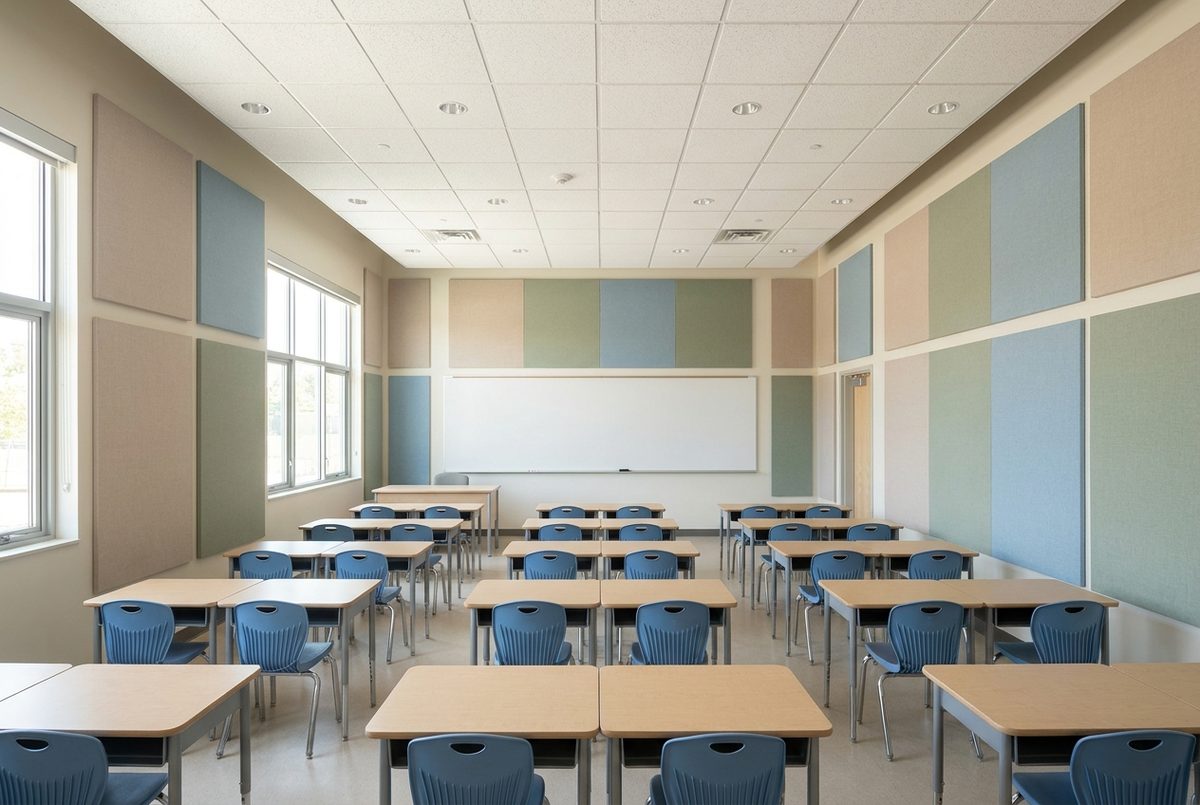
Absorptive panels were placed in his classroom, speech therapy room and auditorium. The panels in his classroom are removable and will be moving with him from year to year. Double-paned windows, a new roof vent, and a quieter clock were placed in the speech therapy room. The toilet and clock were replaced in his classroom. Four aluminum wheelchair ramps near his classroom were covered with rubber matting. “Quiet Zone” was painted in areas surrounding his classroom and speech therapy room.
I did need to make a number of sacrifices, but I felt these were necessary in order to maintain good relations with district staff. It is important to understand that an appropriate learning environment is a balance of acoustics, temperature and lighting. The acoustical engineer's recommendation required replacing the louvered windows in the classroom with double-paned windows. Since the windows were the main source of ventilation, it did not make sense to replace them since they would be open anyway. Of course, I could have required the district to meet the standards as written in the IEP, but this would have required installation of an HVAC system at a cost of approximately $20,000–$25,000.
The district then started talking about modifying one room that my son would stay in for his entire elementary school years and require teachers to rotate through the room. Classrooms are a teacher's world, and I envisioned being greatly disliked by all of his teachers!
Could you estimate the number of children who, in addition to your son, benefited from the acoustic improvements?
It is well-documented in the literature that all children gain from improved acoustics. The following specific populations also receive great benefit:
- D/HH (including children with recurring ear infections)
- Central Auditory Processing Disorders (CAPD)
- Learning Disabilities
- Developmental Delays
- Attention Deficit Disorder or Attention Deficit Hyperactivity Disorder (ADD/ADHD)
- Second Language Learners
To translate this into numbers would include the 20 kids in my son's classroom, any child receiving therapy in the speech therapy room, and all the children who used the auditorium.
How long did it take to complete the project?
The initial IEP addressing the acoustic standards was written in February 2000 and the modifications were completed in October 2000 (even though I stipulated in a subsequent IEP that the modifications be completed by the time my son started school in the fall). Eight months is too long for a project of this size to take. Some of the delays in the project included:
- A significant amount of time was taken negotiating between the Section 504 Office and the Special Education Department to determine who was responsible for funding the project. This is where some legal research came in handy! I was able to provide the district documentation that any child who receives an IEP does not require a 504 plan. This is not typically the role a parent should play, but if I was not persistent in requesting meetings and having discussions, I'm not so sure the project would be complete today.
- There was a period of time when the proposal was not being actively processed by Owens Corning. This was during the summer when a number of individuals who needed to authorize the bid were on vacation.
- After the project was authorized, some issues arose with the school district about exceeding the dollar limit without going out to bid for the project. It was also a non-standard process since Owens Corning was partially contributing to the project which caused a few hiccups.
- The truck delivering the panels ran into an unforeseen delay. This impacted the speech therapist who had dismantled her room in anticipation of the work being done on a specific date. Although a few days may seem minor to the casual observer, the children receiving speech therapy needed to be seen in their classroom, which was not an appropriate environment for this service. The delay also impacted installation since the consultant used by Owens Corning to install the materials had many projects which he could not easily bump back.
Would you estimate the cost involved?
Cost is an important issue for parents to understand. By law, the cost of accommodations cannot be discussed at IEP meetings. However, it is my opinion that cost is the main issue in determining necessary accommodations. The overall cost to the district for all the modifications at the school came to $22,000 with Owens Corning donating $10,000 in the form of testing, supervision and product.
How could an acoustical engineer help parents who want to make acoustical changes?
Acoustical engineers can help educate parents about the importance of improved acoustics in the classroom and supply them with information that could be used in IEP meetings. If needed, professionals could provide a report or participate in the IEP meeting to help convince the district to support these needed modifications. Engineers who are interested in working with school districts should begin to establish relationships with key district staff. Until district personnel have the experience and equipment necessary for testing, they will depend upon consultants to complete the work. Most large districts have the staff to install panels, but would need some supervision during the process. Providing this service and making recommendations that are cost-effective will work to everyone's benefit.
What advice would you give to other parents in working with their school districts?
One of the parent's primary roles is to educate others about D/HH issues. For example the work request stated, “A profound deaf student requires an acoustically treated learning environment per 2/2/00 IEP.” At a planning meeting I talked about residual hearing and how my son, who has a severe-to-profound loss, was able to hear with hearing aids. I even brought in his hearing aids and had the staff listen to them with a stethoset while I walked up and down the aluminum ramp in hard-soled shoes. They gained an appreciation of why containing the noise was so important.
Some other thoughts include:
- Start early. The school bureaucracy moves slowly.
- Be prepared for the district to say that an FM system is sufficient to meet your child's need (it isn't).
- Be flexible and be willing to back down when needed.
- Be a broker of information (I played a key role in making sure individuals spoke with each other).
- If needed, get support from professionals (e.g. letters from acoustic engineers, your child's audiologist) which specifically support your child's needs for appropriate acoustics.
- Finally, don't forget to say “thank you”. When the project was complete, I recognized the hard work of the project manager (who frequently met with me before and after school and on the weekends) by sending a letter to the superintendent.
Glossary
- Absorptive panels
- Wall-mounted panels made of soft material which absorbs sound. They reduce reverberation and noise build-up in a room.
- Ambient noise
- All noises in a given location that are not associated with the sound of interest (“background noise”). Ambient noises can be both external (traffic, children playing) or internal (fans, plumbing), and may or may not be controllable. Levels of ambient noise that are high enough can interfere with speech. Various sources recommend maximum levels of ambient noise in a classroom of between 30 and 45 dBA, with the lower levels preferred for hearing-impaired children.
- ASHA
- American Speech-Language-Hearing Association.
- ASHA position paper
- Position Statement and Guidelines for Acoustics in Educational Settings (March 1995). Lacking other definitive guidance regarding classroom acoustics, ASHA published a paper specifying minimum acoustical requirements for classrooms. Specifically, the requirements are: 1) ambient levels less than 30 dBA or NC-20; 2) signal-to-noise ratios of greater than 20 decibels; and 3) reverberation times of less than 0.4 second.
- D/HH
- Deaf or hard of hearing.
- Home school
- A school closest to the student's residence.
- IEP
- Individualized Education Program. A written statement for each child with a disability that includes, among other things, a statement of supplementary aids and services to be provided to the child. The IEP is defined in the Individuals with Disabilities Education Act.
- Reverberation time
- The time required for a sound in an enclosed space to decay by 60 decibels. Stated another way, the time for a sound to “die out”. Excessive reverberation time tends to garble speech, as is commonly observed in a gymnasium. Very low reverberation times (0.4–0.6 seconds) are preferred in classrooms in order to provide maximum clarity of the teacher's voice. Reverberation times are usually greater in the lower frequencies, where they are the most difficult to control. This presents an extra difficulty for hearing-impaired children as they often have most of their residual hearing in these lower frequencies.
- Stethoset
- A device similar to a stethoscope designed for checking the proper operation of hearing aids.