
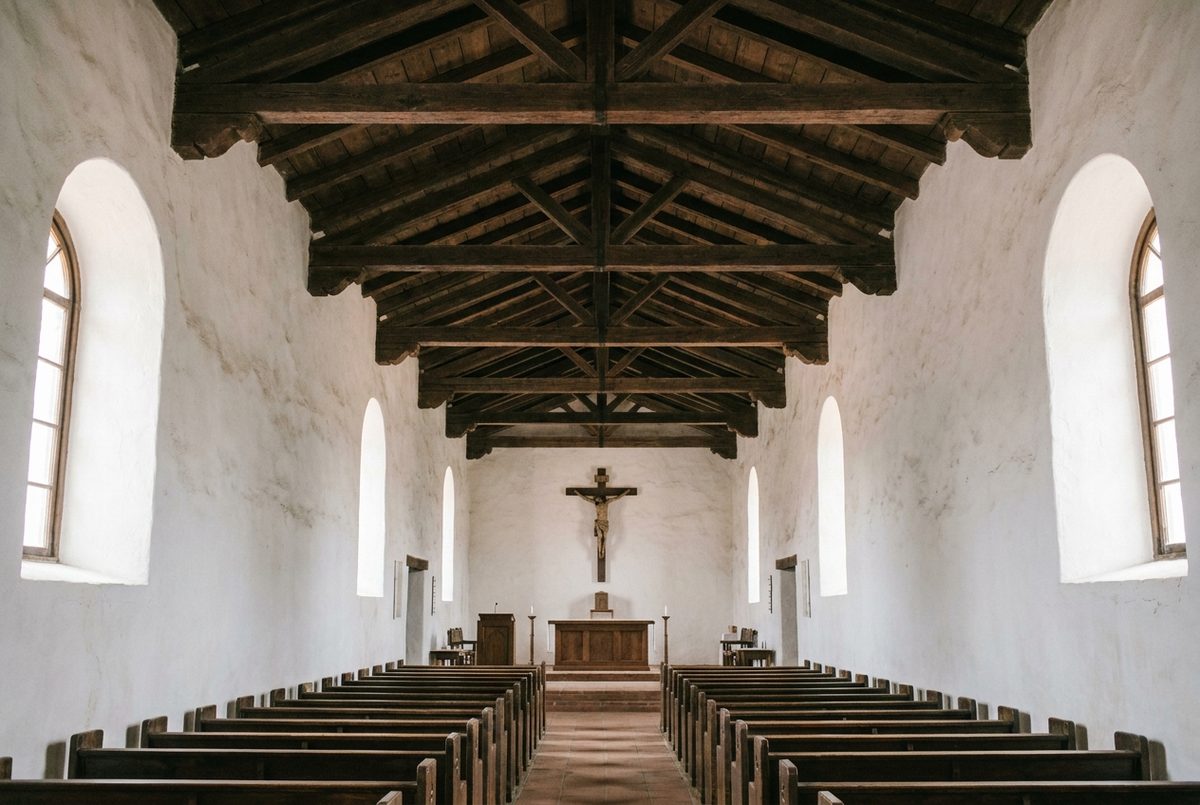
On a weekday evening the choir rehearses in an empty sanctuary of plaster and tile, and every chord hangs in the air. On Sunday the pews fill, the room turns drier, and a visitor in the back rows still struggles to follow the reading. Both impressions are accurate. A worship space has to serve speech and music, with and without its congregation. The arithmetic below shows why church acoustics are hard to get right.
Speech wants a short tail, music a longer one
Reverberation time, RT60, is the time a sound takes to fall by 60 dB after the source stops. In speech, each syllable’s tail overlaps the next one. When the tail is long, consonants can drown in the vowels before them, and listeners far from the speaker lose words. Music works the other way: a longer tail joins the notes of an organ or a choir into one sound.
Published guidance reflects that split. HyperPhysics, the physics reference hosted by Georgia State University, suggests around two seconds for a medium-sized hall used for speech and music. For a classroom it suggests less than a second. An ASHRAE Journal column on acoustics fundamentals agrees in substance: rooms under roughly one second suit speech, and longer times suit music such as organ.
Traditions differ in what they ask of church acoustics. A liturgy built around a pipe organ, a choir and congregational song asks for a live room. A service led from a stage, with a band and projected lyrics, relies on loudspeakers, and a long reverberation works against them. Some congregations hold both kinds of service in the same room.
Church acoustics in numbers: one sanctuary, empty and full
The Sabine formula estimates reverberation time from the room volume and the total absorption. In feet it reads:
RT60 = 0.049 × V ÷ A
V is the volume in cubic feet. A is the total absorption in sabins: each surface area in square feet multiplied by its absorption coefficient, all added up. The constant 0.049 is the metric constant 0.161 multiplied by 0.3048, the number of meters in a foot.
Take a plain rectangular sanctuary with a flat ceiling, 100 ft long, 50 ft wide and 30 ft high: 150,000 ft³. Assume plaster on lath for the walls and ceiling, 1,000 ft² of windows, a vinyl tile floor, and wooden pews over 3,000 ft² of the floor. The coefficients are 500 Hz values from the HyperPhysics table, which cites Hall’s Musical Acoustics. Coefficients like these are measured in a reverberation room under ASTM C423.
| Surface | Area, ft² | Coefficient | Absorption, sabins |
|---|---|---|---|
| Plaster on lath, walls | 8,000 | 0.10 | 800 |
| Plaster on lath, ceiling | 5,000 | 0.10 | 500 |
| Window glass | 1,000 | 0.20 | 200 |
| Vinyl tile, aisles and chancel | 2,000 | 0.03 | 60 |
| Wooden pews, empty (table value for wood seating) | 3,000 | 0.03 | 90 |
| Total | 1,650 |
The walls are the perimeter of 300 ft times 30 ft, less the windows. With nobody in the room, 0.049 × 150,000 ÷ 1,650 gives 4.5 seconds. The table below changes only the pew area: occupied wooden pews, then upholstered seating as a stand-in for cushioned pews.
| Condition | Pew area coefficient | Total absorption, sabins | RT60 |
|---|---|---|---|
| Wooden pews, empty | 0.03 | 1,650 | 4.5 s |
| Wooden pews, occupied | 0.7 | 3,660 | 2.0 s |
| Cushioned pews, empty | 0.6 | 3,360 | 2.2 s |
| Cushioned pews, occupied | 0.8 | 3,960 | 1.9 s |
The congregation more than doubles the absorption here and roughly halves the reverberation time. That is the rehearsal-versus-Sunday difference from the opening. Cushions shrink the gap between empty and full from more than two seconds to about a third of a second. The empty room now behaves almost like a full one.
Treat the example as an illustration, not a design. Coefficients change with frequency, and the same table gives different values at 125 Hz. The low-frequency reverberation of a room can differ markedly from its 500 Hz figure. HyperPhysics also notes that the Sabine formula overestimates reverberation in highly absorptive rooms and ignores air absorption. Real sanctuaries add balconies, chancels and organ cases, and a full church acoustics study has to account for them.
Echoes and focusing
Reverberation is the sum of countless reflections arriving close together. An echo is a single reflection that arrives late and strong enough to be heard as a repeat. In a long nave, a hard rear wall can send the reader’s voice back to the chancel as a distinct, delayed repeat. Parallel side walls can trade reflections back and forth as a flutter, and a curved apse or dome can focus sound onto a few seats.
Early reflections are the helpful kind. The ASHRAE column notes that nearby reflections help carry a speaker’s voice without reducing intelligibility. A ceiling surface or canopy above the lectern returns sound to the congregation quickly enough to reinforce the direct voice.
Sanctuary in longitudinal section, chancel on the left. Schematic, not to scale.
- Direct sound from the lectern to the back pews
- Early reflection from a canopy above the lectern supports the voice
- Late reflection from a hard rear wall returns as an echo
- Absorption or diffusion on the rear wall
- Main loudspeaker aimed at the seats, not the walls
- Delayed loudspeaker for the back rows
- Air outlet: a source of background noise during quiet moments
- Pews: cushions add absorption when the room is empty
Absorption or diffusion on the rear wall takes the echo out without drying the whole room. Hard surfaces near the choir and organ can stay, because their reflections arrive early and support the singers.
The sound system does part of the work
Loudspeakers chosen and aimed at the seats put the spoken word into the pews with less of it striking walls and ceiling. For back rows or a balcony, delayed loudspeakers can be timed so their sound arrives just after the sound from the front, keeping the voice anchored at the lectern.
A sound system cannot cancel reverberation. Once amplified speech reaches the hard surfaces, the room adds its tail to it as well. A system tuned in the empty room will also sound different on Sunday, for the reasons the worked example shows.
Quiet first: mechanical noise and the world outside
A contemplative room needs a low background noise level. The ASHRAE column lists NC-25 for worship and music venues, and the guide to NC curves explains how that is measured and where HVAC noise comes from. A diffuser that hisses through a moment of silence can be fixed in design, with lower air velocity and quieter outlets.
Outside noise matters too. For highway projects under the federal noise rule, places of worship are among the uses with an interior criterion of 52 dBA Leq(h). The guide on how traffic noise is assessed under CEQA shows that table. A fellowship hall, nursery or music room beside the sanctuary raises a different question: sound isolation. The guide to sound isolation ratings for walls and floors explains how that is rated.
Changes that keep the room’s character
- Cushions on the pews narrow the gap between the empty and the full room, as the example shows.
- Absorption or diffusion on the rear wall removes the late reflections that start echoes.
- Carpet limited to aisles and circulation keeps the floor near the singers reflective.
- Reflective surfaces stay near the choir, the organ and the lectern.
- Measurements before and after: RT60 by octave band in the empty room, plus background noise with the HVAC running.
Houses of worship are on the list of room acoustics work in the firm’s architectural acoustics services, and churches appear among its listed clients. The other ratings that turn up on a church project are summarized on the guides page.
Questions clients ask
Should we carpet the whole sanctuary?
Think twice. In the HyperPhysics table, heavy carpet on concrete absorbs little at 125 Hz and much more at 2,000 and 4,000 Hz. Wall-to-wall carpet therefore takes brilliance out of the room while leaving the bass reverberation in place. Carpet in the aisles plus cushioned pews changes the room far less.
Why is the sermon clear up front but not at the back?
The direct sound from the person speaking weakens with distance, while the reverberant sound fills the room fairly evenly. Toward the back the balance tips toward reverberation, and words blur. Loudspeakers aimed at the rear pews, delayed fill loudspeakers and treatment of the rear wall all move the balance back.
Will acoustic panels make congregational singing sound dead?
That depends on where they go and how much area they cover. Panels on the rear wall and high on the side walls deal with echoes and excess reverberation. Surfaces near the congregation and the choir can stay hard, so singers still hear each other. A Sabine estimate like the one above shows how far a treatment moves the room before anything is installed.
Can a new sound system fix a reverberant room?
It can help a great deal by sending sound to the seats instead of the walls. It cannot remove the room’s own tail, because amplified sound reverberates like any other. In a very live sanctuary the loudspeakers and some room treatment have to work together.
Standards and sources
- HyperPhysics, Reverberation Time, Georgia State University: definition and desirable values by room use.
- HyperPhysics, Modeling Reverberation Time: the Sabine formula, its limits and the absorption coefficient table.
- ASTM C423-23e1, sound absorption and sound absorption coefficients by the reverberation room method.
- ASHRAE Journal, Engineer’s Notebook, “Learning a Vocabulary for Acoustics Fundamentals”: reverberation for speech and music, NC-25 for worship venues.
- 23 CFR 772, Table 1: Noise Abatement Criteria, places of worship in categories C and D.