
A conference room sits one floor below a rooftop unit. The sound level meter shows a modest A-weighted reading. Yet people at the far end of the table lean in, and a low rumble fills every pause on the video call. The reading was correct and still missed the problem. Noise Criterion (NC) curves rate background noise band by band, in a form an HVAC engineer can act on.
How NC curves rate a room
Background noise from building systems is measured in octave bands with the HVAC running, typically from 63 to 8,000 Hz. Each NC curve is a reference spectrum. It allows more sound at low frequencies, where hearing is less sensitive, and less at high frequencies. The measured spectrum is plotted against the family of curves, and the rating is the highest curve that any band touches.
An ASHRAE Journal column on acoustics fundamentals shows the method with a quiet church. One octave band sits higher against the curves than all the others, and that single band sets the rating at NC-27. Every other band could drop and the rating would not change.
The current American National Standard on room noise is ASA/ANSI S12.2-2026, Criteria for Evaluating Room Noise. It provides two methods: the A-weighted sound level and NC curves. Both assume a steady noise from heating, ventilating and air-conditioning equipment.
Why one dBA number is not enough
A-weighting turns the low-frequency bands down before adding everything into one number. That makes it a good survey tool and a poor rumble detector. Caltrans makes the general point in its Technical Noise Supplement: very different spectra can produce the same A-weighted level. Two rooms at the same dBA can sound nothing alike, one with a fan rumble and the other with a hissing diffuser.
NC curves keep the bands apart, so the band that sets the rating also tells the engineer where to look. A rating controlled at 63 or 125 Hz often points toward the fan and the duct system. One controlled at 2,000 Hz or above often points toward air rushing through grilles and diffusers.
The ASHRAE column adds a second warning. If equipment produces a tonal peak above the curve in any band, people notice it and find it irritating, because it does not blend into the neighboring bands. A motor hum can therefore spoil a room whose overall level looks fine.
Rumble, hiss and RC Mark II
An NC curve rating looks at the highest point of the spectrum, not at its shape. The room criterion method published by ASHRAE, RC Mark II, adds a code for the character of the sound, such as RC 40(LF) for rumble or RC 40(MF) for roar. In a laboratory study reported in Acoustics Today, perceived HVAC noise affected task performance in ways that NC, RC Mark II and dBA did not fully capture. A diagnosis needs both the measured spectrum and a listening visit.
Targets from public guidance
NC targets usually come from the design brief and the specifications. Two public sources give useful starting values. The U.S. General Services Administration publishes guidance for federal offices, and the ASHRAE Journal column lists typical values for other room types.
| Space | Target | Source |
|---|---|---|
| Open plan workspace | NC-40 maximum | GSA, Sound Matters |
| Private office, normal speech privacy | NC-35 maximum | GSA, Sound Matters |
| Private office, confidential speech privacy | NC-30 maximum | GSA, Sound Matters |
| Meeting rooms, training facilities | NC-25 maximum | GSA, Sound Matters |
| Teleconference facility | NC-20 maximum | GSA, Sound Matters |
| Worship and music venues | NC-25 | ASHRAE Journal, Engineer’s Notebook |
| Broadcast studio, music performance | NC-20 | ASHRAE Journal, Engineer’s Notebook |
The office rows show how background noise and partitions work as a pair. GSA asks for a quieter background in the confidential office and, in the same guidance, a higher noise isolation class between rooms. Noise isolation class is one of the field measures described in the guide to STC and field isolation ratings.
Classrooms have their own American National Standard, ANSI/ASA S12.60. Part 1 sets background noise limits in both dBA and dBC, and the C-weighted limit picks up rumble that A-weighting turns down. The classroom acoustics interview on this site shows how NC-20 ended up in one student’s education plan. Worship spaces sit at the quiet end of the table too. The ASHRAE column notes that a contemplative room must let people hear soft consonants and quiet music, as the guide to the acoustics of worship spaces explains.
Where HVAC noise gets into a room
A rumble can arrive by several paths at once, so it helps to trace them one at a time. The diagram follows sound from a rooftop unit into the room below.
Noise paths from a rooftop unit into the room below, vertical section. Schematic, not to scale.
- Fan noise travels down the supply duct with the air
- Breakout: noise radiates through the duct walls into the ceiling space and the room
- Regenerated noise from air turbulence at the damper and the diffuser
- Vibration into the roof structure, reduced by spring isolators
- Airborne noise from the unit casing through the roof
- A rigid conduit or pipe can bridge the isolators
Each path has its own remedy. Duct-borne fan noise is reduced with lined duct or a silencer between the unit and the first quiet room. Breakout is reduced by routing the main duct away from that room or by heavier duct construction. Regenerated noise calls for lower air velocity near the outlets and quieter dampers and diffusers.
Structure-borne noise is a question of mounting. The unit stands on vibration isolators, the duct connects through a flexible section, and nothing rigid bridges the isolators. A single conduit or pipe strapped tight to the frame can short-circuit the isolation.
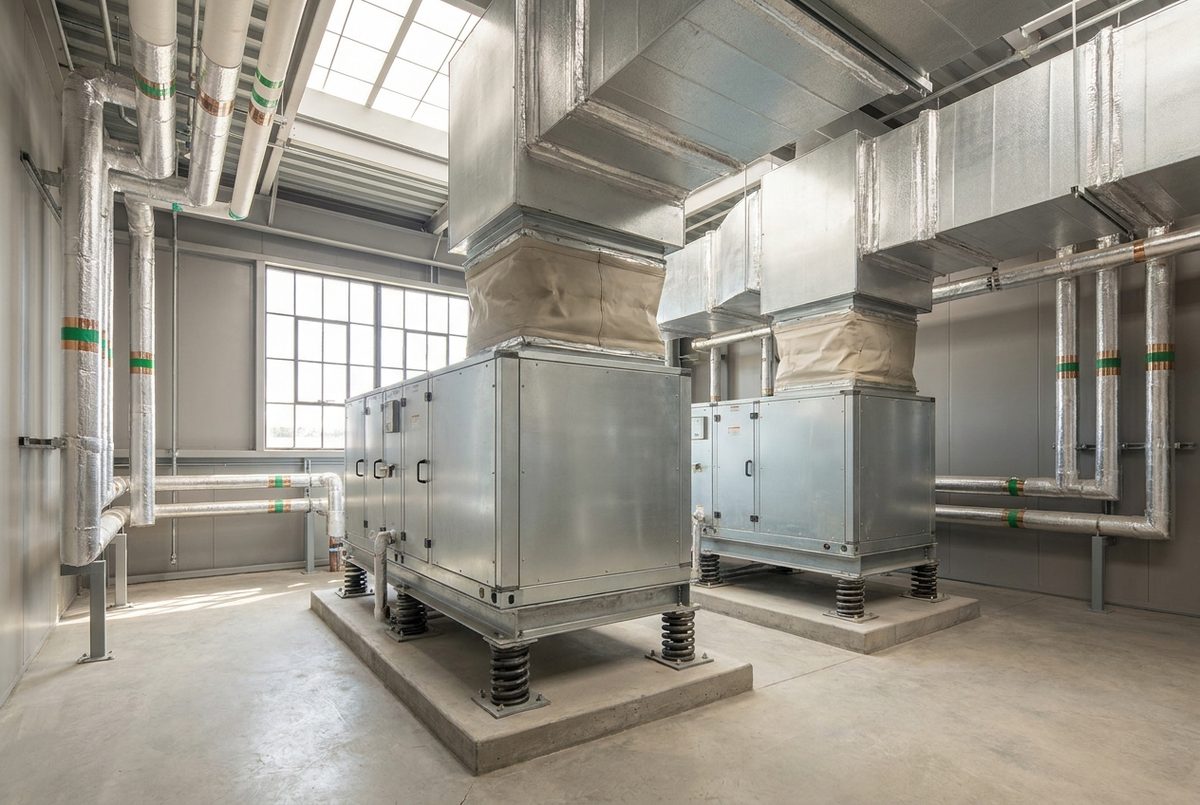
Picture a remodel in which new acoustical ceiling tiles go into the boardroom and the rumble stays. The tiles shortened the reverberation, which is what absorbers do. The rumble came down the supply duct, and only work on the duct path will remove it.
Measuring it properly
- Measure in the unoccupied room with the system at its normal operating airflow, at the positions where people sit.
- Record octave bands. A single A-weighted reading cannot be turned back into a spectrum afterward.
- Take a second set with the system off. The difference separates HVAC noise from traffic and neighbors.
- Use a calibrated sound level meter. The ASHRAE column warns that phone apps are not calibrated for low-frequency or very quiet readings.
The firm measured ambient and background noise with a Larson-Davis 824 sound level meter and real time analyzer. Its architectural acoustics services listed low noise HVAC among the treatment recommendations. The same rooftop unit can also be a neighbor’s problem, which brings operational noise in a CEQA study into play. The guides overview places NC next to the other ratings used on a project.
Questions clients ask
What NC should we design a conference room for?
Public guidance points to the quiet end of the scale. GSA’s Sound Matters lists NC-25 as the maximum for meeting rooms and training facilities and NC-20 for teleconference facilities. A room used mostly for video calls deserves the stricter value, because the microphones pick up the rumble that people in the room tend to tune out.
Our room measures NC-35, but people complain about a hum. Why?
The rating comes from octave bands, which lump a narrow tone together with the noise around it. A hum from a motor, a transformer or a fan can stand out to listeners while the octave band containing it looks unremarkable. The answer is a one-third octave or narrowband (FFT) measurement to find the frequency, then a search for the source that produces it.
Is NC the same as dBA?
No. ASA/ANSI S12.2-2026 treats them as two separate methods. A dBA value is one weighted total. An NC rating compares each octave band with a set of curves and reports the highest curve reached. Two rooms can share a dBA value and differ in NC, and the reverse is also possible.
Can sound masking cover up HVAC noise?
Masking is a deliberately added, controlled sound used for speech privacy in open offices. GSA pairs it with a background noise limit of NC-40 for open plan workspaces. Masking is designed to be smooth and steady. It does not cure a rumble or a tone from the HVAC, and adding it on top of one makes the room louder still.
Standards and sources
- ASA/ANSI S12.2-2026, Criteria for Evaluating Room Noise: A-weighted level and NC curves.
- U.S. General Services Administration, Sound Matters: background noise, isolation and masking targets for offices.
- ASHRAE Journal, Engineer’s Notebook, “Learning a Vocabulary for Acoustics Fundamentals”: NC values by room type and the NC-27 church example.
- ASHRAE Handbook, HVAC Applications, chapter on noise and vibration control: the RC Mark II method.
- Acoustics Today, research on indoor noise criteria, perception and task performance.
- ANSI/ASA S12.60, acoustical performance criteria for schools: A- and C-weighted background noise limits.
- Caltrans, Technical Noise Supplement: A-weighting and why one level can hide different spectra.